Tuesday, 15 March 2016

The Scandinavian Art - Finland

As as great fan of all Andrew Graham-Dixon's TV programmes & documentaries I thought that first part of Scandinavian Art was brilliant shown on BBC2 14/3/2016.
 
I am hopeful that very interesting, remarkable and often symbolic Finnish art gets mentioned in the series later.
 
Geographically, the Scandinavian Peninsula includes what is today mainland Sweden and mainland Norway. A small part of northwestern Finland is sometimes also considered part of the peninsula. In physiography, Denmark is considered part of the North European Plain, rather than the geologically distinct Scandinavian Peninsula mainly occupied by Norway and Sweden. However, Denmark has historically included the region of Scania on the Scandinavian Peninsula.(New World Encyclopedia )
 
We have had a freedom of movement (no passports needed) between Finland, Sweden, Norway and Denmark since 1954.Between Iceland since 1955 and since1966 with the Faroe Islands.The Nordic Council which is geo-political and inter-parliamentary forum for co-operation the Nordic countries was founded 1952. The Nordic Countries have their respective histories but we are interwined in many ways.

Around 800AD is Viking period and affecting Finland. People from Kainuu ( = Pohjanmaa ) area are known to go on battle trips to Norway robbing and raiding.

1154AD Arabic scientist Al-Idrisi writes that Finnish  (Fymark) king owns land in Norway.1200AD Saxo Grammaticus, Danish historian, also writes about Finnish kings.1202 the Danes try to invade Finland.
 
Some quick notes on remarkable Finnish art.

I am here flying a Finnish flag as we were part of Sweden over 700 years.1809 Tsar Alexander I attacks Finland and Finland becomes an autonomous Grand Duchy of Russia.Finland became independent 1917.Sweden has alwayas had a great influence on Finnish art.Many of our talented painters and artists studied in Stockholm and Paris on the 17th and 18th century.The Finnish composer Jean Sibelius and painter Akseli Gallen-Kallela were passionate about Finland's independence and it was heard and seen in their works of art; many powerful ones based on the national epoc Kalevala.There are many more artists that can be named for their work.


Today Finnish design and architecture are doing well, always looking forward to new ideas and inventions.
 
 
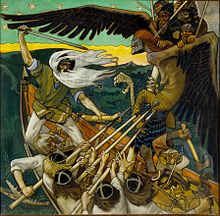
 Akseli Gallen-Kallela 1865-1931
 
   
The Aino Triptych 1891                                                     
The Defence of Sampo 1896               
Lemminkäinen's Mother 1897
 
 
 Symposion, lopullinen maalaus (tai toinen versio)
Symposion, painting by Gallen-Kallela - heavy drinking artists Jean Sibelius on the right
 
 
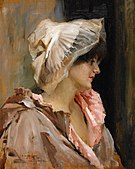
Albert Edelfelt 1854-1905
 
 
Christ and Mary Magdalene       Parisien Lady   Summer        Two women with laundry
 
 
Pekka Halonen 1865-1933


In the sauna 1925  Washing in the ice 1900   Autumn landscape 1914
 
 
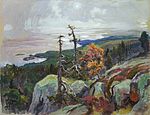
Eero Järnefelt 1863-1937
 
           
 Burning the brushwood 1893 View of Koli 1935  Portrait of Saimi his wife


Alexander Laureus 1783-1823
 
 
Portraits of artist's stepmother Mariana Juliana Winqvist and her two sons by Aleksander Lauréus
 
 
Helena Sofia Schjerfbeck 1862-1946
 
 
Self portrait 1915                       Family heirlooms 1916
 
 
Ferdinand von Wright 1822-1906
        
View from Lugnet 1899   The Fighting Capercaillies 1886
 
 
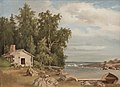
Magnus von Wright 1805-1868
 
    
Annankatu Helsinki  Beach of Lehtisaari
 

Wilhelm von Wright  1810-1887


Wednesday, 9 March 2016

Literate Finland The Washington Post - Valerie Strauss

Most literate nation in the world? Not the U.S., new ranking says

(Correction: Central Connecticut State University has released a corrected version of the rankings. The U.S. moves up from 11th to 7th.)

A new world ranking of countries and their literacy rates puts the United States at 7th. Who’s No. 1? Finland.
The study, conducted by John W. Miller, president of Central Connecticut State University in New Britain, Conn., analyzes  trends in literate behavior and literacy in more than 60 countries. It found that Nordic countries are among the most literate in the world but countries in the Western Hemisphere didn’t do well.
Here are the rankings:

Miller has concentrated his academic work for four decades on literacy, producing  “America’s Most Literate Cities” survey from 2003-2014 in collaboration with Central Connecticut’s Center for Public Policy and Social Research.

In a statement, he said: “The factors we examined present a complex and nuanced portrait of a nation’s cultural vitality, and what the rankings strongly suggest and world literacy demonstrates is that these kinds of literate behaviors are critical to the success of individuals and nations in the knowledge-based economics that define our global future.”

The rankings look at variables related to tested literacy achievement — scores on the PIRLS, or Progress in International Reading Literacy Study, and on the PISA, Programme for International Student Assessment — as well as to literate behavior characteristics. Those include 15 variables grouped in five categories: Libraries, Newspapers, Education System – Inputs, Education System – Outputs, and Computer Availability, as well as population, which is used for establishing per capita ratios.
Given that the scores on international students tests are questionable measures of how one country really does over another for a variety of reasons, it is fair to wonder how they skew the results of these rankings. Miller addresses the issue somewhat in the statement, saying that the results would be  “very different” if PIRLS and PISA were the only factors. He said:
“The Pacific Rim countries, Singapore, South Korea, Japan, and China, would top the list if test performance was the only measure. Finland would be the only non-Pacific Rim country to rank high. When factors such as library size and accessibility are added in, the Pacific Rim nations drop dramatically.”
If, of course, he had only looked at student test scores, it wouldn’t have been much of a literacy ranking.
Valerie Strauss covers education and runs The Answer Sheet blog.
 

Friday, 22 January 2016

Teaching migrants how to behave / BBC News Helsinki

Teaching migrants how to behave

  • 22 January 2016
  • From the section Magazine BBC
Magazine
 
Migrants arriving in Finland are being offered classes on Finnish values and how to behave towards women. Concerned about a rise in the number of sexual assaults in the country, the government wants to make sure that people from very conservative cultures know what to expect in their new home.
Johanna is one of those energetic, animated teachers whose cheerful energy lures even the most reluctant pupil into engaging with the lesson. She uses both her hands to stress her meaning and she always softens any difficult points with a smile.

"So in Finland," she says softly, "you can't buy a wife. A woman will only be your wife if she wants to be - because here women are men's equals."
Her pupils, all recently arrived asylum seekers at this reception centre hidden away in the snowy depths of the Finnish forest, watch her carefully - and I watch them. Some of the young Iraqi men, who already speak good English and passable Finnish, nod sagely. Others, particularly the older men, stare at one another with raised eyebrows as Johanna's words are translated into Arabic for them. One man, hunkered down inside his black ski jacket seems to be taking notes while there's a faint smile on the lips of the only head-scarfed young woman in the room.
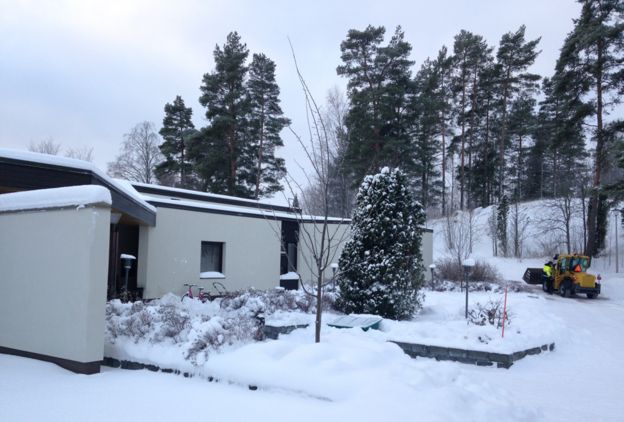
Raasepoori reception centre
Image caption Raasepoori reception centre in the Finnish forest
"But you can go out to the disco with a woman here," adds Johanna brightly. "Although remember, even if she dances with you very closely and is wearing a short skirt, that doesn't mean she wants to have sex with you."
A Somali teenager pulls his woolly hat over his ears and cradles his head in his hands as if his brain can't cope with all this new information.
"This is a very liberal country," he says incredulously. "We have a lot to learn. In my country if you make sexy with a woman you are killed!" He turns to his neighbour, a Malian man of a similar age to gauge his reaction.
"It's quite amazing," the Malian nods. "In my country a woman should not go out without her husband or brother."
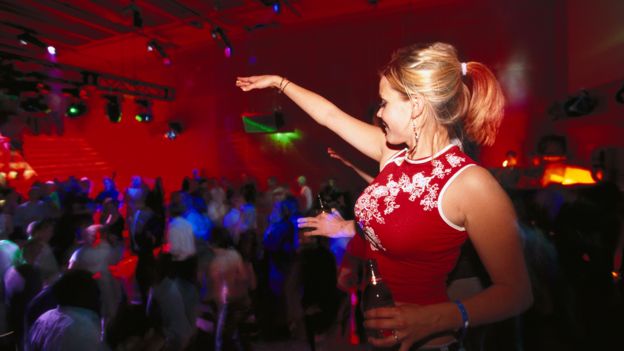
Woman at a disco in FinlandImage copyright Alamy
Johanna turns her attention to homosexuality and the Iraqi men on the back row - it's always the back row - begin to giggle and snigger.
It might seem like a bit of a pantomime, but reception centres in Finland take these voluntary manners and culture classes extremely seriously. If men arriving from very different and conservative cultures are not immediately made aware that Finland has its own set of customs and rules which must be respected, then they will never integrate, warns Johanna.

The men may groan when she tells them that Finnish men share the housework, but they no longer baulk when they see their taxi driver is a woman. Since the autumn, when Johanna first started giving these classes, female asylum seekers frequently approach her to complain that their husbands are not treating them in the Finnish way. The men are also versed in Finnish criminal law so they know exactly what to expect if they touch a woman inappropriately.

And that's why these classes are backed by the interior ministry and the police. Last autumn three asylum seekers were convicted of rape in Finland, and at the new year there was a series of sexual assaults and harassments similar to those in Cologne and Stockholm. Victims reported that the perpetrators were of Middle Eastern appearance - something Helsinki's deputy chief of police, Ilkka Koskimaki decided to go public with.
"It's difficult to talk about," he admits as we drive in a patrol car through the icy streets of the city. "But we have to tell the truth. Usually we would not reveal the ethnic background of a suspect, but these incidents, where groups of young foreign men," as he puts it, "surround a girl in a public place and harass her have become a phenomenon."
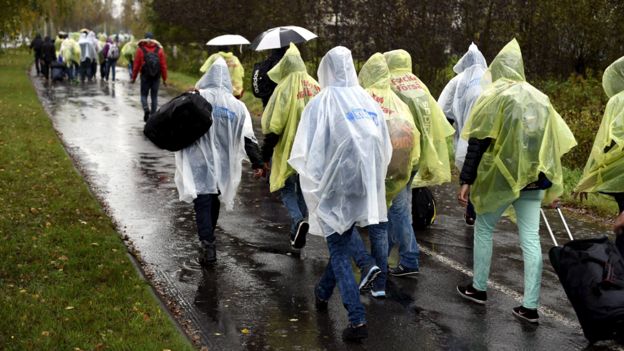
Refugees walk from a public transport centre to a reception centre in Tornio, north-west Finland, September 2015.Image copyright Getty Images
Image caption More than 32,000 migrants arrived in Finland in 2015
The police van pulls up at a downtown reception centre where Koskimaki's preventive policing team give similar classes to Johanna's. A jumble of migrant men smoking on the snowy steps in flip-flops, hastily scarper indoors, clearly alarmed by the police presence. A muscly Iraqi man in gym kit approaches me cautiously and asks me in a whisper why I feel the need to visit the centre with three police bodyguards. Please, he pleads, please don't think all asylum seekers are dangerous because of a few criminals.

The lesson at Raasepoori reception centre is drawing to a close and the asylum seekers have been given optional homework to help them read up on Finland's sexual equality laws. As we leave the class, an Iraqi man in a colourful bomber jacket shakes my hand.
"It's great in Finland," he says "But when I marry, my wife will be a housekeeper who will cook the food I like - and she certainly won't go to discos."

How to listen to From Our Own Correspondent:
BBC Radio 4: Thursdays at 11:00 and Saturdays at 11:30. Listen online or download the podcast.
BBC World Service: At weekends - see World Service programme schedule or listen online.
You can also listen to a longer radio report from Finland by Emma Jane Kirby which was broadcast on The World at One.
Subscribe to the BBC News Magazine's email newsletter to get articles sent to your inbox.